
English| EUR
Suggested for you
More currencies
Choose a language
Mount Etna's temperature drops roughly 6°C for every 1,000 meters of elevation gain. What feels mild at the cable-car station becomes arctic at the craters. Understanding these thermal zones determines what you pack and when you climb.
Quick answer
Etna tour temperature varies dramatically by altitude: the base areas around Rifugio Sapienza sit at 1,900 meters with summer highs near 20°C and winter lows around 0°C, while the summit craters at 3,300 meters experience temperatures 10–15°C colder, with strong winds adding severe wind chill. Even in July, the upper slopes can drop below freezing before sunrise. Tours departing between 08:45 and 09:30 catch stable morning conditions before thermal updrafts and afternoon cloud cover arrive.
Mount Etna operates under three distinct climate zones stacked vertically across 2,400 meters of elevation. The cultivated foothills below 1,000 meters enjoy Mediterranean warmth year-round. The forested belt between 1,000 and 2,000 meters marks the transition into alpine conditions. Above 2,100 meters the landscape turns lunar, and temperature becomes the governing factor for every excursion. The practical impact shows in the numbers. A summer morning at Piano Provenzana might register 18°C at 09:00, comfortable for the cable-car ride. By the time guided groups reach 2,900 meters on foot, that figure has dropped to 6°C, and summit winds at 3,300 meters routinely subtract another 10°C through wind chill. Winter inverts the comfort window entirely: base temperatures hover near freezing, and the upper volcano enters arctic territory with readings below -10°C common from December through March. Snow persists on the north face into May. Weather volatility compounds the altitude effect. Etna generates its own microclimate through thermal convection, pulling moisture from the Ionian Sea and condensing it into clouds that engulf the summit by midday in warmer months. Morning departures between 08:45 and 09:30 align with the clearest skies and calmest winds. Afternoon tours face cloud cover, reduced visibility, and temperature swings as the sun angle shifts. The volcano's active vents add localized heat anomalies, where fumaroles radiate warmth against otherwise freezing air, a contrast that defines the summit experience. Layered clothing systems prove essential because static temperature readings omit the wind factor. A 5°C reading at Torre del Filosofo becomes -8°C effective temperature in a 30 km/h wind, standard for exposed ridges. Guides recommend base layers, insulating mid-layers, and windproof shells regardless of season. The etna tour temperature reality separates prepared visitors from those who abort ascents halfway. Gloves, hats, and sun protection coexist in the same pack because ultraviolet exposure intensifies with altitude even as air temperature drops. The volcanic terrain reflects heat unevenly, creating microclimates within meters of each other, a phenomenon that makes real-time adaptation more useful than forecast memorization.
“A 5°C reading at Torre del Filosofo becomes -8°C effective temperature in a 30 km/h wind, standard for exposed ridges.”
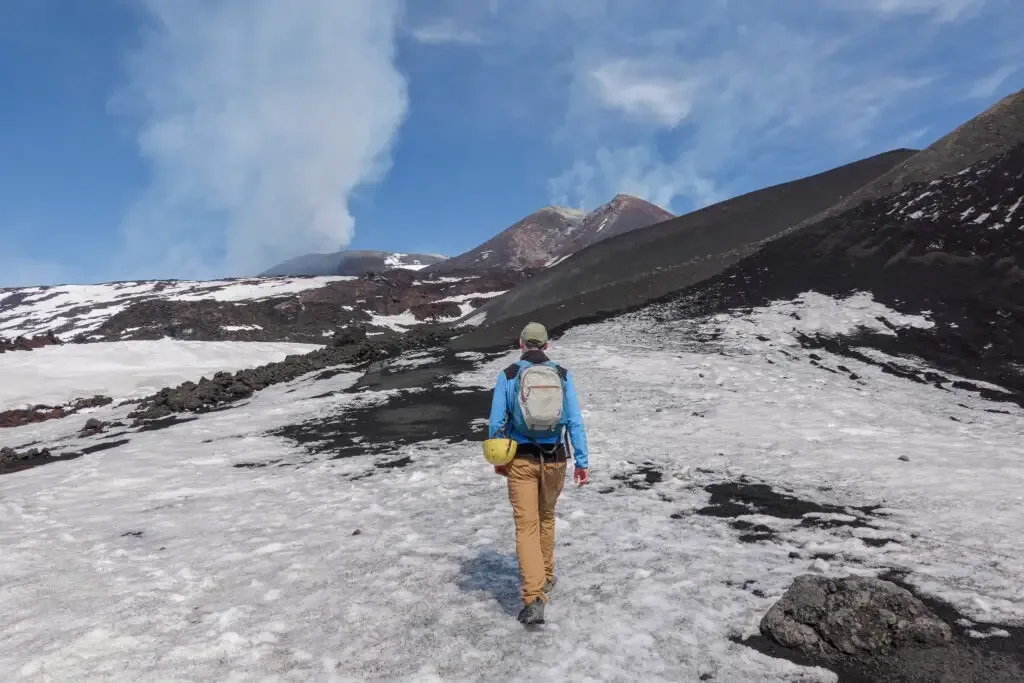
Rapid elevation changes on Etna create temperature swings of 15–20°C between base and summit, so layered clothing and wind protection are essential.
Mount Etna operates daily to accommodate visitors seeking cooler hiking conditions during the morning hours. Planning your arrival within these scheduled times helps ensure access to the park areas.
Mount Etna National Park does not charge an entrance fee for visitors accessing general park areas. Costs associated with touring the volcano primarily relate to specialized transport required to reach higher, colder altitudes.
Verdict: A typical visitor pays 0 EUR for park entry, with final costs determined by the mode of transport selected to reach higher elevations.
Mount Etna is located in the Metropolitan City of Catania, with the primary access point for excursions situated at 95031 Adrano. Most visitors reach the higher volcanic elevations by car or bus via the provincial roads connecting to the Sapienza Refuge area.
SP92 from Catania to Rifugio Sapienza
AST bus line from Catania Central Station
Etna trail network from main parking
Plan your arrival for the best arrival window of 08:45–09:30. This strategy helps avoid midday crowds and heat while ensuring you encounter clearer morning skies and cooler temperatures for your ascent.
Everything you need to know about etna tour temperature
The temperature on the volcano can shift rapidly depending on altitude and wind exposure. Visitors often experience cooler conditions than in the coastal areas of Catania.
A guided trek to the summit or crater areas requires preparation for cold winds and variable weather. Layers are essential because the climate at higher elevations is much cooler than at the park base.
Conditions are generally alpine, meaning they remain cool even during warmer months in Sicily. It is common for high-altitude winds to make the air feel colder than recorded readings suggest.
Yes, the air thins and cools as you ascend toward the summit craters. Planning your visit for the best arrival window of 08:45–09:30 helps ensure you experience more stable morning weather.
We advise arriving early between 08:45 and 09:30 to avoid the midday heat and enjoy clearer skies. This early window provides the most comfortable conditions for exploring the volcanic landscape.
Dress in breathable layers that can be added or removed as the terrain changes. Ensure children have sturdy footwear and adequate protection from the sun and wind regardless of the date.
Etna Sunset Excursions
Read more GuideEtna Excursion Prices
Read more Tickets & toursEtna 4x4 Excursions
Read more GuideEtna Lava Flow Excursions
Read more GuideEtna Excursion Reviews
Read more Tickets & toursEtna Excursions from Catania
Read more Tickets & toursEtna Excursions from Taormina
Read more Tickets & toursEtna Summit Tours
Read more